Creating an OER allow you to tailor resources to your students' needs and learning outcomes while contributing to a more accessible and equitable educational environment. This section provides suggested OER creation tools and information on Creative Commons licensing to help guide you along the creation process.
Are you interested in creating an OER or adapting one? Then you should apply for the OER Development Grant!
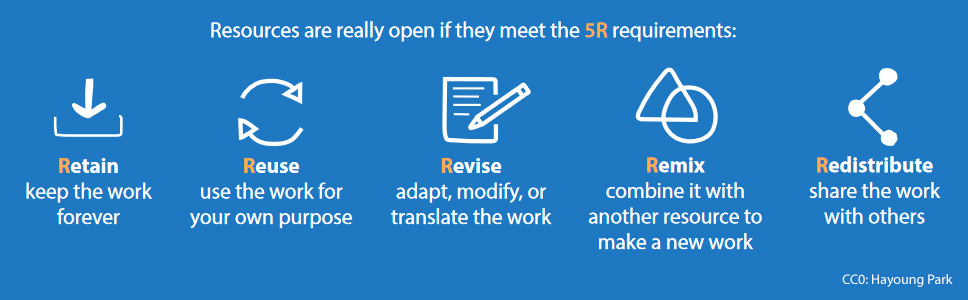
Open Educational Resources (OER) are any copyrightable work (or in the public domain) that is licensed in a manner that provides users with free and perpetual permission to engage in the 5R activities:
Retain - the right to make, own, and control copies of the content (e.g., download, duplicate, store, and manage)
Reuse - the right to use the content in a wide range of ways (e.g., in a class, in a study group, on a website, in a video)
Revise - the right to adapt, adjust, modify, or alter the content itself (e.g., translate the content into another language)
Remix - the right to combine the original or revised content with other material to create something new (e.g., incorporate the content into a mashup)
Redistribute - the right to share copies of the original content, your revisions, or your remixes with others (e.g., give a copy of the content to a friend) be retain, reuse, revise, remix and redistribute.
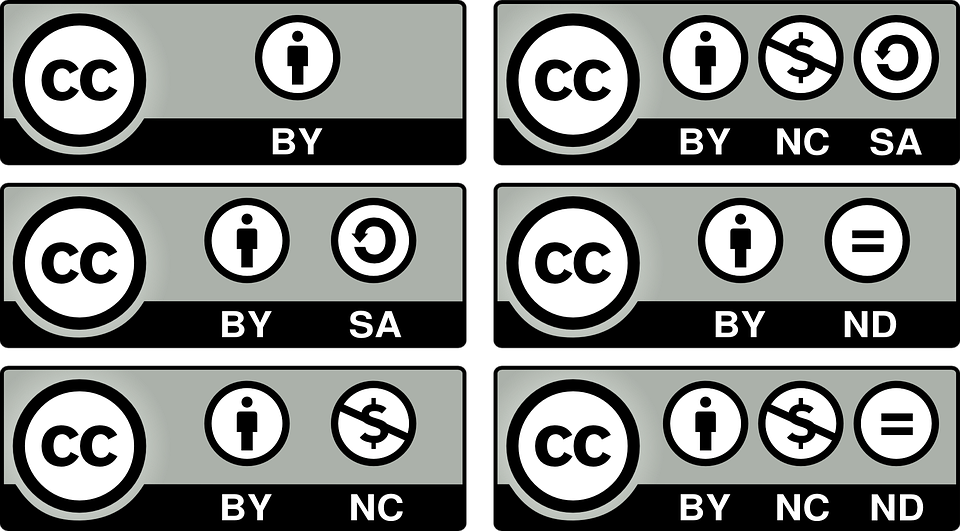
Creative Commons is a non-profit organization that promotes the use of Open Educational Resources by providing copyright licenses that provide both protections for the content creator and permissions for those wanting to use that creator's content. It is the application of a Creative Commons license that most clearly identifies an Open Educational Resource.
There are currently six available Creative Commons licenses to choose from. They are: